


Research Article :
Suad Al Junaibi,Asma Nasser Al Yahya’ei,Aziza Nasser Al Rahbi,Bushra
Abdullah Al Battashi,Iman Hamed Al Ghaithi,Kahwla
Abdullah Al Raqadi,Maha Ahmed Al Hinai,Marwa Mohammed
Al Farsi,Nawar Abdullah Al Suti,Sameera Said Al
Mashari and Sara Said Al Sudairi Joining college for the
first time might be a difficult experience for most students as the
transitional stage from being a student of secondary school to one in a college
can lead to problems in terms of adjusting to college life. There are multiple
aspects that students need to adjust to in college life such as social,
academic, lifestyle, institutional attachment, and personal-emotional aspects. The aim of this project
was to identify the common adjustment issues among first-year students enrolled
in the foundation program at the Oman
College of Health Sciences (OCHS). To achieve the purpose of the project, a
survey comprising 26 points and subdivided into four parts was designed using a
Likert-type scale. A sample of 200 first-year students (mean age=19yrs.) at
OCHS were randomly selected to be surveyed from total of 374 students. However,
only 188 students participated in the survey: 48 males (25.5%), and 140 females
(74.5%). The gathered data were entered and analyzed through the google forms
service. The results showed lack of entertainment to be the main issue with
first-year students followed by concerning economic problems, social and
wellbeing issues. The findings indicated that Extracurricular
Activities (ECAs) within and outside the college play an important role in
the students academic performances and have positive effects on their lives.
Such students will also be able to alter their behavior, improve their
learning, develop their personality, and increase
their teamwork and leadership skills. The
transitional stage from being a student in secondary school to one in a college
can lead to problems in adjusting to college life. Some students may even
experience long-term emotional maladjustment and depression
[1]. In addition, entering an unfamiliar environment with different
responsibilities may cause some maladjustment problems during the first year of
most students in certain aspects such as social, academic, lifestyle,
institutional attachment and personal-emotional adjustments. Further, Extracurricular
Activities (ECAs) may also be considered as an influencing factor that
considerably affects the students lives. Maladjustment
to the above-mentioned factors can significantly affect the academic
performance, mental
health, personal development, quality of life and other aspects in the life
of a first-year college student. According to Erik Eriksons stages of psychosocial
development, children between 12 and 18 years of age are at a stage of
identity vs. role confusion, and “The individual who receives proper
encouragement and reinforcement through personal exploration will emerge from
this stage with a strong sense of self and a feeling of independence and
control” [2]. If the individual fails to be independent or does not know what
they want, this can lead to role confusion. Furthermore, it has been found by
Sheng and Zhu that university learning is the key period for college students
to transition from the role of a student to a good, socialized individual role
[3]. Such a stage is considered to be of great importance in shaping the
students cognition,
emotion,
and will, which play a big role in the attainment of happiness for contemporary
college students. Nowadays,
ECAs have become an important part in each university and college as it may
affect the students lives in college. Many colleges deal with ECAs as it is a
source of joy for the students and also helps them to identify their talents.
Moreover, ECAs increase their involvement in college and their productivity as
well. Furthermore, ECAs play a significant role in developing the characters
and personalities of the students. In the Oman College of Health Sciences
(OCHS), no separate committee exists that is responsible for the ECAs on
campus. The student
affairs committee takes direct responsibilities for the ECAs, and there is
a lack of an obvious role for ECAs in the college. This project aims
to: · Identify the
adjustment problems that can be found among the first-year students at OCHS. · Create and
distribute a survey to identify the most common problems faced by first-year
students. · Recommend
suggestions based on the study findings. Significance of
the Project: To
evaluate whether the first-year students of OCHS are able to accommodate and
adjust to the transitional
problems and issues of being a college student. Literature review:
This
project discusses some of the studies that support the statements related to
ECAs at OCHS and their positive effects on the students lives. Such effects may
include improved mental status, time management, self-confidence, learning,
personality development, teamwork cooperation and leadership, as well as
positively altered behaviors and motivation to set goals. Such a comprehensive
list of positive effects will in turn help them to achieve high academic
performance. This health
educational project is considered to be a supportive study for the fresher
students, who are the primary target of the project. Studies
indicate that participation in ECAs can help adolescents to develop themselves
and set goals during their transition from adolescence to adulthood while at a
university. This will help them to achieve high outcomes in their academic
performance and will also help them to adjust with their emotional status [4].
Hence, higher educational agencies should support and direct their students to
participate in these activities in order to adjust with their problems. When
first-year students participate in ECAs in the college campus, it encourages
them to explore their hobbies and capabilities during the second year of
college life in a way that increases their self-confidence and relieves them
from the pressure and stress of only focusing on studies. Researchers indicate
that the personality traits and happiness of college students help them to
better understand themselves by recognizing the factors that affect their
personality [3]. This
health educational project discusses the existence of ECAs inside the campus
amongst freshmen. Due to the hardships of their transition from high school to
college, new college students need more activities to explore their emotions
and use their energy to be productive and creative. Also, as mentioned
previously, for freshmen to perform well in their academic activities, it is
important for them to be exposed to an entertaining environment and to be
provided with good support from the college council by encouraging them to
participate in ECAs and simultaneously supporting them in their studies. They
should be reassured and guided that with proper time management, participation
in ECAs inside and outside the campus will not affect their academic
performance. Additionally, it is important to bring to their attention that
participating in and organizing these activities will help them to develop
relationships with various people. Sheng
and Zhu found that ECAs do not only help the students to relax but also help
them to exercise their management ability, organizational ability, communication
ability and other abilities, which add to the students knowledge and
enhance their personal skills [3]. For example, a case study shows that
participation in extracurricular sporting activities had a positive impact on
the students academic performance in higher education as it was found to be
associated with higher grades among students at the university level [5]. It
was also found by Zaman those ECAs such sports, student councils, and music,
art, and drama clubs can improve the self-esteem and alter the attitude and behavior
of a person [6]. It
could also be argued that if students participate in ECAs, it will increase
their collaborative and cooperative attitude whenever there is a teamwork
activity. They will also learn to possess leadership
skills, which will increase their self-esteem and confidence. The results
of a cross-sectional study highlighted the students who had participated in
ECAs such as college clubs generally scored better in their examinations and
learned new skills such as working in a team and leadership, while decreasing the
likelihood of different problem behaviors [7]. Music
was found to inspire the students to learn by uplifting their moods. It was
stated in a study that music was considered to be a fun activity that the
students enjoyed and helped to make them more motivated [8]. This study proved
that music can change students moods and make them happier and less stressed.
Moreover, the study found out that the students who listened to music while
studying was had better academic performances. Chan
also asserted that there is a positive relationship among ECAs, the learning
approach and academic performance [9]. Moreover, Bakoban and Aljarallah found
out in their statistical study that participation in ECAs affected the students
Grade
Point Average (GPAs) in a positive way as those who participated in ECAs
had higher GPAs than those who did not [10]. They also found that the time
spent on participating in ECAs did not affect the time that students usually
spend on studying. Billingsley
and Hurd state that non-participating students have lower GPAs and feel bad
when compared to students who participate in ECAs and get higher GPAs and who
feel more confident about their achievement [11]. In another study, Arranz et al.,
highlighted the more positive effects of ECAs beside enjoyment such as an in
increase in the students awareness, especially when exposed to college trips
and campaigns at different places [12]. It was mentioned in the study that
extracurricular and curricular activities are equally important in a students
life. ECAs help refresh the students minds and prepare them to focus better on
their study besides improving their knowledge; for example, participating in
trips to various places increases the students knowledge about those places. It
also improves their style of learning and communicating with others. This will
help them to be more mentally prepared to attend other college activities. Research design: This study is
conducted using a quantitative descriptive research design to elicit the
information from first-year students at OCHS regarding adjustment issues with
college life. Setting of the
study: The
study is conducted in the OCHS main campus in Muscat. The registry of
first-year students is accessed through the OCHS registration and acceptance
section. Population: There are 374
students registered at the OCHS foundation program in Muscat (academic year
2018/19). Sample: First year
students who are fulfilling the inclusion criteria after reviewing through the
foundation program registry with the help of the program head are approached
for the study. Sample size calculation=190, total population (374), acceptable
error margin (5%). Confidence level=95% Sampling
technique: Convenient
sampling is used. Number of samples from OCHS first-year students is calculated
based on the proportionate number of foundation students who is admitted during
data collection period. Slovins
formula for sample size calculation, n=N/(1+Ne2). Where: n=no of samples,
N=total population (374), e=acceptable error margin / margin of error (0.05). Hence n=374/1+374 x 0.0025=187 Inclusion
criteria: ·
Students
in the age group of 18 years and above ·
Students
admitted in the academic year 2018/19. Exclusion
criteria:
Students who are repeating the foundation program. Data collection
instrument: The
survey constituted of 26 points that were subdivided into four parts, which
were designed and measured by a 5-point likert-type scale. The four parts were
economic issues, social issues, wellbeing related issues and entertainment
issues. Such themes were carefully selected to help assess the most common
issues first-year students may encounter during their college time. A pilot
study was conducted to check the feasibility of the application of the survey.
The survey was distributed among a small sample of students (25 first-year
students) and was found to be a reliable tool. The survey questions were found
to be ideal for the language and knowledge levels of the OCHS students.
Therefore, the survey was used as the main tool for gathering data for the project. The
survey was conducted by randomly selecting 200 freshmen students
(males/females) to answer the survey after being asked for their consent.
Subsequently, the survey was subjected to a descriptive statistical
analysis. The target population sample of the survey was 200 students (mean
age=19yrs.) of the OCHS foundation program, but the actual number of participants
who responded and contributed to the survey was 188 students: 48 males (25.5%),
and 140 females (74.5%). The
survey data were entered using the Google Forms service and then using the excel
application for analysis. All the points that were included in each part of the
survey were analyzed in detail. The results are presented according to the
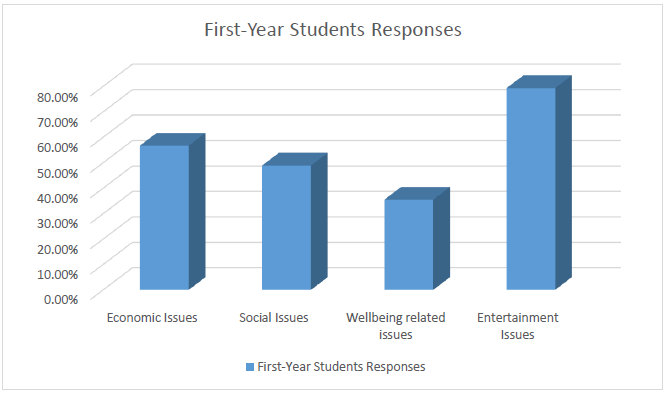
percentage of responses for each part. In terms of the entertainment issues
part, which highlighted the main concerns of the survey participants, the
results show that 79.3% of the participants strongly agree that there are no
recreational services in OCHS, and there is no interest in conducting sporting
activities at the college Figure 1. Figure: 1 First year student’s
response. In
the economic issues part, 56.7% of the participants strongly agree that the
high cost for transportation and meals with the lack of allocation of monthly
expenses to the students, which pose serious economic
problems that, require attention. In the social issues, 48.9% of the
participants strongly disagreed with the availability social support services.
In the wellbeing issues part, 35.5%of the participants agreed that they had
poor sleep habits and they were sleepy in the classroom. Also, the meals provided
in the canteen were unhealthy, the canteen environment was unclean, and the
timing of the lectures was not convenient for them. The
lack of entertainment and recreational services in the OCHS, as reflected in
the results, is considered to be the main issue concerning freshmen. As
reflected earlier in the literature,
participating in ECAs, whether inside or outside the college, is considered to
be of prime importance for freshmen to help them relieve the various stresses
they encounter in their first year of higher studies. Guilmette et al, Muñoz-Bullón
et al, and Ahmad et al, linked participation in ECAs to higher outcomes in
academic performance [4,5,7]. On the contrary, Billingsley and Hurd stated that
the non-participating students had lower GPAs [11]. This
indicates the importance of the abundance of such activities in colleges in the
foundation year and beyond. Zaman listed several ECAs that freshmen students
could participate in and which would have positive effects on their
personalities [6]. Such activities included sports, administration activities,
and music, art, and drama clubs. The other problems that had been stated by the
participants also intervened with their academic performance, whether it was in
terms of economic aspects, social and wellbeing aspects. All of these issues
had negative impacts in one way or another on the students academic
performance, and they definitely interacted with the lack of ECAs in impacting
academic performance negatively. The
participants indicated that excessive academic commitments proved to be
stressful. Furthermore, the stressful college environment and lack of social
support were all harmful to their health, which was ultimately reflected by
poor academic performance. Guilmette et al clarified that freshmen students
achieve better outcomes when they adjust emotionally [4]. Sheng and Zhu also
indicated that the personality traits of college students helped them to better
understand themselves by recognizing the factors that affected their happiness
[3]. Hence, by pinpointing the strengths and weaknesses in their personalities,
the freshmen will be able to adjust emotionally, alter their behavior, and
organize themselves better, which will eventually improve their academic
performance. Such positive effects on their personalities and behaviors are a
direct result of participating in ECAs, as stated by Sheng and Zhu and Zaman,
and other researchers [3,6]. The other social and personal skills that will be
gained from participating in ECAs are teamwork and leadership skills which will
benefit them throughout their academic life [7]. Furthermore,
it could be argued that the lack of academic support from the college
administration, as claimed by the students, is due to the poor communication
and relationship between the students and their tutors. Many students have
stated that some tutors are biased to particular students, due to which they
provide limited support to some students. This makes them feel disappointed and
thus affects their academic performance. Also, their inability to convey their
needs in an efficient manner to their tutors because of language barriers makes
it difficult for them to express the shortages in their academic skills. Hence,
a good student-tutor relationship is essential for improving the students
academic performance to ensure a smooth transition from the first year to the
following academic years. From
the above argument, it is obvious that ECAs are considered to be prerequisites
for improving the academic performance of all students. Therefore, it is
advised that OCHS consider improving the support services provided to freshmen
as it has been proved that they are vital for better outcomes in the students
academic performances and for smooth transition from the first-year to the
subsequent academic years. According
to the survey results, ECAs are a major issue at the Oman College of Health
Sciences. Therefore, to resolve this issue, it was important to hold a workshop
jointly with the student affairs assistant deanship at the college to discuss
the ECA matters. Another important part is to create a booklet which would help
first-year students. Suggestions
include the following: ·
Provide
a corner in the library with various genres other than the medical
and health fields. ·
Provide
special halls for various events like cultural, sports, artistic, and literary
activities. ·
Allocate
a cinema hall to screen cultural or entertaining movies every month. ·
Organize
a day for student entrepreneurs to showcase their products and projects. ·
Hold
periodical talent competitions to select the best talents such as the best
photographic, best actor, best chef, best singer, etc. ·
Have
an open day for students-a recreational day-to break their monotonous routines,
which will motivate them to get back to their studies with enthusiasm. A
workshop was conducted to discuss the suggestions that had been raised with the
student affairs section and the students council well. The contents of a booklet
were also discussed during this workshop and found to be satisfactory. The
student affairs section agreed about the importance of ECAs in the college.
Furthermore, the contents of the booklet focused on the students needs,
especially of those residing in hostels. Some examples of the contents of the
booklet are contacts of the nearest restaurants, shopping malls, gyms, and
gardens, in addition to other entertaining activities such as camping. The
booklet was designed based on the locations in which the students reside in
Muscat. The considered places that will be included in the booklet are
Al-Aamirat, Bawsher, Al-Athaiba, Al-Khuwair, Ruwi, Al-Wattaya, and Al-Qurum. This
project clearly highlighted that 79.3% of first-year students who participated
in the survey agreed that there was a lack of entertainment and ECAs inside and
outside the college campus, which demanded the attention of the college
administration. In response to such an alarming fact, a step by step approach was
followed to provide the college administration with the most appropriate
solutions. Consequently, an orientation booklet was created to help the
students to be aware of the ECAs inside and outside the college. In addition, a
workshop was conducted in the college to discuss the matter with the student
affairs sections and the students council to come up with most appropriate
solutions which will be implemented by next academic year. In
conclusion, this project discussed the issues faced by the first-year students
during their foundation program at the Oman College of Health Sciences (OCHS).
The participants emphasized the lack of ECAs as the main issue faced by the
students. Awareness of the benefits of ECAs was raised in a joint workshop with
the student affairs section within the college. Limitations The
student participation was less as the survey was conducted during the end of
the semester (final exams). 1.
Ababu BG, Yigzaw BA, Besene DY and Alemu
GW. Prevalence of adjustment problem and its predictors among first-year
undergraduate students in Ethiopian university: a cross-sectional institution
based study (2018) Psy J 25: 2018-5919743. https://doi.org/10.1155/2018/5919743 2.
Cherry K. Erik
eriksons stages of psychosocial development. psychology (2017) Psychosocial
Theories. 3.
Sheng
Y and Zhu C. Research on the Influencing Factors and Improving Path of
Contemporary College Students Happiness (2019) Edu and Human Rese 310:
1664-1668. https://doi.org/10.2991/iccese-19.2019.366 4.
Guilmette
M, Mulvihill K, Villemaire-Krajden R and Barker TE. Past and present
participation in extracurricular activities is associated with adaptive
self-regulation of goals, academic success, and emotional wellbeing among
university students (2019) Learn and Indivi Differ 73: 8-15. https://doi.org/10.1016/j.lindif.2019.04.006 5.
Muñoz-Bullón F, Sanchez-Bueno MJ and
Vos-Saz A. The influence of sports participation on academic performance among
students in higher education (2017) Spor Man Revi 20: 365-378. https://doi.org/10.1016/j.smr.2016.10.006 6.
Zaman F, Rafiullah and khan ZJ. Positive
impact of extracurricular activities on university students in lahore, Pakistan
(2017) Int J Soci Sci Man 4: 22-31.
https://doi.org/10.3126/ijssm.v4i1.16339 7.
Ahmad M, Rahman MF, Ali M, Rahman FN and
Al Azad MAS. Effect of extracurricular activity on students academic
performance (2015) J of Arm Forc Med Coll 11: 41-46. https://doi.org/10.3329/jafmc.v11i2.39822 8.
Antony
M, Priya VV and Gayathri R. Effect of music on academic performance of college
students (2018) Drug Invent Today 10: 2093-2096. 9.
Chan
YK. Investigating the relationship among extracurricular activities, learning
approach and academic outcomes: a case study (2016) Active Learning in Higher
Education 17: 223-233. https://doi.org/10.1177/1469787416654795 10.
Bakoban
RA and Aljarallah SA. Extracurricular activities and their effect on the
students grade point average: statistical study (2015) Edu Res Rev 10:
2737-2744. https://doi.org/10.5897/err2015.2436 11. Billingsley
JT and Hurd NM. Discrimination, mental health and academic performance among
underrepresented college students: the role of extracurricular activities at
predominantly white institutions (2019) Soci Psy Edu 22: 421-446. https://doi.org/10.1007/s11218-019-09484-8 12.
Arranz
N, Ubierna F, Arroyabe M F, Perez C and de Arroyabe JCF. The effect of
curricular and extracurricular activities on university students entrepreneurial
intention and competences. Studies in Higher Education (2017) Tayl Fra 42: 1979-2008. https://doi.org/10.1080/03075079.2015.1130030 Junaibi
SA, Department of Prevention and Security of Care, Oman College of Health
Sciences, Sultanate of Oman, Oman, Tel: +968 99455354, E-mail: bintmusa@hotmail.com Junaibi
SA, Al
Yahyaei NA, Al Rahbi NA, AL Battashi BA, Al Ghaithi IH, et al. Experiences of
foundation year students at Oman college of health sciences (2019) Nursing
and Health Care 4: 53-56. Extracurricular activities, First year Students, Academic
performances.Experiences of Foundation Year Students at Oman College of Health Sciences
Full-Text
Abstract
Introduction
Objectives of
the project
Date Collection
Data Analysis
Discussion of
Findings
Recommendations
and implications
Summary of the
Findings
Conclusion
References
*Corresponding author
Citation
Keywords
